Top 5 Functional Exercises for Daily Life Activities
5 Functional Exercises That Mimic Daily Life
Imagine this scenario. You spent six months hammering leg extension machines, leg curls, and pristine barbell bench presses. You feel invincible. Your arms stretch your sleeves; your quads look carved from oak. Then, on an ordinary Tuesday, you reach into the backseat of your car to grab a fifty-pound bag of dog food while twisting sideways.
Crack.
Your lower back fires a lightning bolt straight into your glutes. You collapse against the rear fender, paralyzed by an everyday chore.
How can a human who leg presses four hundred pounds get folded by a bag of kibble?
The short answer: isolation movements train muscles, but real life demands movement patterns.
We have spent decades worshipping the bodybuilder paradigm—isolating individual muscle groups, sitting on padded vinyl machines, and moving weights along fixed two-dimensional planes. But nature never gave us padded seats or linear lever paths. Real life is chaotic, asymmetrical, heavy, and dynamic. Real life demands that we pull an overhead bag out of an airplane bin, lug awkward suitcases up three flights of stairs, or sprint across a muddy trail without blowing out an ACL.
If your workout routine stops working the moment you step off the rubber gym mat, you haven’t built strength. You’ve built an illusion.
Functional fitness burns down that illusion. It bridges the chasm between raw muscle volume and real-world utility, reprogramming your central nervous system to wield force in three-dimensional space.
The Illusion of the Mirror Muscle: What Neuroscience Reveals About Real Strength
To understand why traditional workouts break down outside the gym, we need to inspect how the human brain actually controls movement.
Your motor cortex doesn’t think in terms of “biceps” or “hamstrings.” It thinks in patterns. When you reach down to pick up a toddler who just darted toward traffic, your brain fires a complex symphony of motor units across fascial chains, stabilizing your trunk through intra-abdominal pressure while simultaneously rotating your hips and bracing your shoulder girdle.
Machine training strips away this neuromuscular coordination. When you sit in a chest press machine, the steel track does all the stabilizing for you. Your rotator cuff slumbers. Your deep core musculature relaxes. Your brain learns a lazy neurological path: push force forward without worrying about balance.
The moment you attempt that same push against an unstable, unpredictable object in the real world—like pushing a stalled car out of an intersection—your stabilizing muscles panic. The brain shuts down primary power output to protect your spine, leaving you weak, clumsy, and vulnerable to soft-tissue damage.
Real functional capacity isn’t about how much raw weight you can press along an artificial groove. It is about spatial intelligence, fascial tension, and kinetic continuity—the ability to transfer energy seamlessly from the ground through your toes, up through your hips, across your torso, and out through your hands.
The 5 Real-World Movements That Mimic Human Life
If we want to build a resilient, adaptable body that thrives under real-world stress, we must train movements, not isolated parts. These five exercises break down artificial gym boundaries and restore your innate human capability.
1. The Farmer’s Carry: Rebuilding Grip, Trunk Stability, and Real Endurance
Consider the most common heavy lifting task on earth: carrying stuff. Suitcases, groceries, bags of mulch, sleeping children, industrial gear. We rarely hold heavy loads symmetrically in front of us while standing still. We carry them while moving across uneven ground, one step at a time.
The Farmer’s Carry appears deceitfully simple. You pick up two heavy kettlebells, dumbbells, or trap bars and start walking. Yet beneath its simplicity lies a masterclass in whole-body stabilization.
       [ Heavy Weight ]                       [ Heavy Weight ]
              \                                      /
               (Arm)                                (Arm)
                 \                                  /
            [ Shoulder Girdle Packed Down & Back ]
                             |
                   [ Core / Lateral Bracing ]
                             |
                     [ Hips / Glutes ]
                             |
                [ Single-Leg Stride Impact ]
Why It Mimics Real Life
When you walk with weight, every single step forces your body into a single-leg stance. Your contralateral gluteus medius and lateral core sloshes into gear to prevent your pelvis from dumping sideways. Your grip strength—often the ultimate proxy for biological longevity and cardiovascular health—gets hammered into steel. Your traps, rhomboids, and lats lock together to prevent your shoulders from pulling out of their sockets.
How to Execute It Like a Pro
- Pick up two heavy weights off the floor using a clean hip hinge (do not round your back).
- Stand tall. Pull your shoulders back and down, as if packing them into your rear pockets.
- Look straight ahead toward the horizon.
- Take slow, deliberate, heel-to-toe steps. Avoid rushing or leaning forward.
- Bracing tip: Imagine someone is about to punch you in the gut while you breathe smoothly around that tension.
The Real-World Carryover
You will stop dreading double-trips from the trunk of your car with twenty-five plastic grocery bags. Your posture while sitting at a desk for eight hours will noticeably improve because your spinal erectors and upper back muscles have developed genuine muscular endurance.
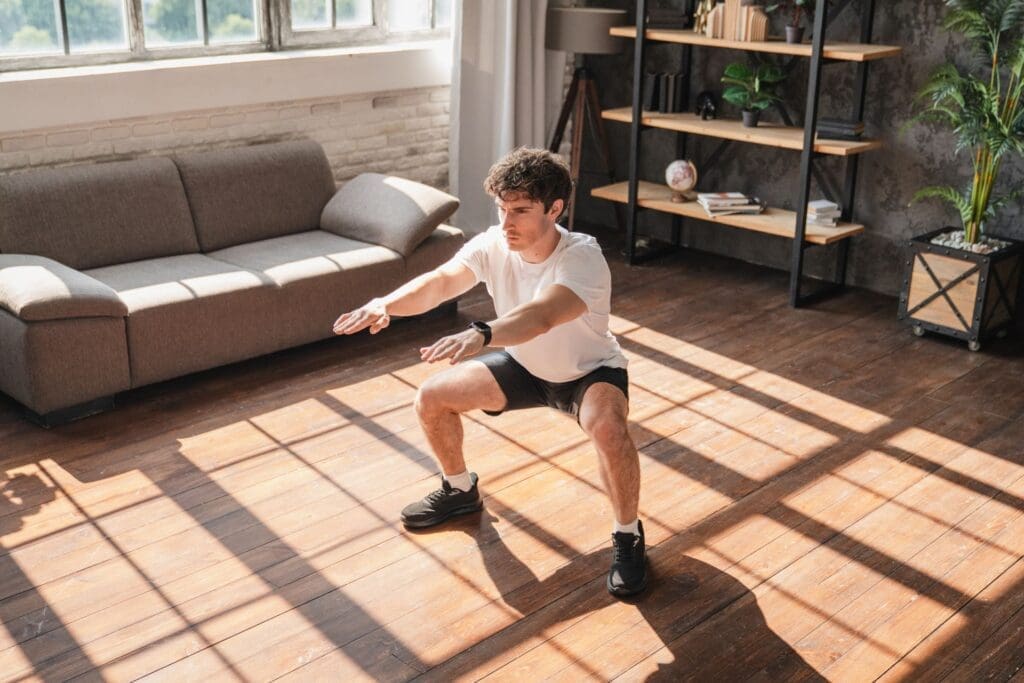
2. The Goblet Squat: Unlocking Deep Mobility and Effortless Lower-Body Power
Most adults treat sitting down and standing up like an existential crisis. We groan when exiting low sofas. We lean heavily on coffee tables to stand up from floor games with our nieces or nephews.
The standard barbell back squat is an incredible tool, but placing a heavy steel bar across your upper spine requires high shoulder mobility and often induces excessive axial compression on the lumbar spine for beginners. The Goblet Squat flips the script.
Why It Mimics Real Life
Holding a single weight against your sternum acts as a natural counterweight. This allows your pelvis to sink deep between your knees without rounding your lumbar spine. It mirrors picking up a heavy box off a low shelf, lifting an anchor off a boat deck, or squatting down to fix a water pipe under the sink.
   [ Kettlebell / Dumbbell at Chest ] <--- Counterweight
               \
                [ Upright Torso / Neutral Spine ]
                 /                             \
     [ Knees Tracking Out ]           [ Knees Tracking Out ]
               |                               |
        [ Feet Flat ]                    [ Feet Flat ]
How to Execute It Like a Pro
- Hold a dumbbell or kettlebell vertically against your chest, gripping it like a goblet.
- Set your feet slightly wider than shoulder-width, pointing your toes out 15 to 30 degrees.
- Inhale deep into your stomach, drive your knees outward in line with your toes, and sit your hips back and down.
- Sink until your elbows touch the insides of your thighs while keeping your chest high and proud.
- Drive through your entire foot—heel, big toe, pinky toe—to push the floor away and return to standing.
The Real-World Carryover
Deep squatting restores hip mobility lost to decades of sitting on desk chairs. It lubricates the cartilage in your knees and ankles while training your legs to exert maximal force from deep, biomechanically awkward angles.
3. The Turkish Get-Up: Total Spatial Intelligence and Joint Resilience
If you were to design a single exercise to test human movement literacy, this is it. The Turkish Get-Up (TGU) forces you to start flat on your back on the floor with a weight held suspended overhead, stand all the way up to a tall position while keeping that weight locked overhead, and then reverse the entire process back down to the floor.
It sounds bizarre. It looks complicated. It is absolute magic for human durability.
Why It Mimics Real Life
Life happens on the floor. Falling over, rolling up, standing up without using hands, reaching overhead while kneeling—these are fundamental human patterns. The TGU takes your shoulder through almost every plane of motion under continuous load, training your core to resist unwanted rotational forces while your hips navigate through lunges, bridges, and side-planks.
How to Execute It (Simplified Breakdown)
- The Roll & Press: Lie on your side, grip a light kettlebell with both hands, roll onto your back, and press the weight straight up over your right shoulder. Bend your right knee, placing your foot flat on the ground.
- The Roll to Elbow: Push off your right foot and roll onto your left elbow, keeping your eyes locked onto the weight above you at all times.
- The Push to Hand: Press up onto your left palm.
- The High Bridge: Drive through your heels and squeeze your glutes to lift your hips high off the floor.
- The Sweep: Sweep your left leg back under your body, placing your left knee on the floor right beneath your hip.
- The Lunge Stand: Straighten your torso into a half-kneeling position, then stand tall.
- The Reverse: Step back into a lunge with your left leg and execute the steps in perfect reverse order.
[ Lie on Back ] ──> [ Roll to Elbow ] ──> [ Push to Hand ]
                                               │
                                               ▼
[ Standing Tall ] <── [ Half-Kneel Lunge ] <── [ High Bridge & Sweep ]
The Real-World Carryover
This exercise acts as bulletproofing for your shoulders and spine. If you stumble on an icy pavement or slip while hiking downhill, the TGU endows your nervous system with instinctual landing mechanics and mid-fall stabilization skills that prevent catastrophic breaks and tears.
4. The Single-Leg Romanian Deadlift (SLRDL): Fixing Asymmetries and Hinge Control
Human locomotion is asymmetrical. We walk, run, jump, and climb one leg at a time. Yet, almost all traditional gym strength work is bilateral—two feet bolted to the floor in perfect symmetry.
When both feet stay grounded, your strong side happily compensates for your weak side. Over months and years, these subtle muscular imbalances widen into massive movement dysfunctions. The Single-Leg Romanian Deadlift eradicates those blind spots.
Why It Mimics Real Life
Think about bending over to pick up a dropped set of keys while carrying a bag of dry cleaning, or leaning over a fence to grab a gardening tool. You rarely bend on two stiff legs with perfect symmetry. You balance on one leg while hinging at your hips.
How to Execute It Like a Pro
- Stand tall on your right leg with a slight bend in your right knee. Hold a dumbbell in your left hand.
- Inhale, brace your core, and begin hinging at your right hip, pushing your glutes straight backward behind you.
- Allow your left leg to float backward in a straight line with your torso, like a seesaw.
- Keep your hips square to the floor—do not let your open hip rotate upward toward the ceiling.
- Lower the weight until your torso reaches parallel to the floor (or until your hamstring feels a deep stretch).
- Drive through your right heel, squeeze your right glute, and return to an upright position.
The Real-World Carryover
The SLRDL builds indestructible hamstrings and glutes while fortifying ankle stability. It drastically reduces your risk of lower back strain by teaching your pelvis to hinge properly around the hip joints rather than rounding through the lumbar vertebrae.
5. The Push Press: Explosive Energy Transfer from Ground to Sky
The traditional seated overhead shoulder press isolates the shoulders by removing your lower body entirely. But outside the gym, when you need to put a heavy piece of luggage into an overhead compartment, drive a kayak up onto a roof rack, or push a heavy box onto a high garage shelf, you don’t isolate your shoulders. You use your legs to generate kinetic momentum and transfer that force up through your core into your upper body.
The Push Press re-links your upper and lower bodies into a single explosive engine.
Why It Mimics Real Life
It teaches timing, coordination, and athletic force production. It trains your body to absorb kinetic force through your knees and hips, then redirect that force upward smoothly.
 [ Dip: Knees Bend 2-3 Inches ]
              │
              ▼
 [ Drive: Explosive Leg Extension ]
              │
              ▼
 [ Transfer: Energy Surges Through Core ]
              │
              ▼
 [ Lockout: Dumbbells Drive Overhead ]
How to Execute It Like a Pro
- Stand with your feet shoulder-width apart, holding two dumbbells at your shoulders with palms facing each other (neutral grip).
- Keep your torso upright and perform a quick, shallow “dip”—flexing your knees and hips just two to three inches down.
- Immediately reverse the motion, explosively driving through your heels to extend your hips and knees.
- Use the upward momentum generated by your legs to drive the dumbbells overhead until your arms lock out fully over your ears.
- Lower the weights back to your shoulders under control and reset.
The Real-World Carryover
You build overhead pressing power without placing excessive fatigue on your deltoids. More importantly, you train your brain to mobilize your entire kinetic chain when pushing against heavy, resistant objects above your head.
Comparative Matrix: Traditional Gym vs. Functional Real-World Training
| Traditional Machine / Isolation | Functional Movement Equivalent | Real-World Functional Benefit | Primary Neuromuscular Focus |
|---|---|---|---|
| Seated Leg Extension | Goblet Squat | Rising effortlessly from low furniture, climbing steep stairs | Quad engagement synchronized with glute/core stabilization |
| Biceps Curl / Lat Pulldown | Farmer’s Carry | Carrying heavy luggage, bags, and gear over long distances | Grip endurance, trap recruitment, postural integrity |
| Seated Dumbbell Shoulder Press | Push Press | Lifting heavy objects onto high shelves or vehicle roof racks | Kinetic chain force transfer from lower body to upper limbs |
| Lying Leg Curl | Single-Leg Romanian Deadlift | Bending down safely on uneven ground, single-leg stability | Unilateral hamstring strength, hip hinge, ankle balance |
| Machine Abdominal Crunch | Turkish Get-Up | Standing up off the floor safely, falling protection | Multiplanar core resistance, shoulder stabilization |
The Dark Side of Functional Hype: Skepticism, Nuance, and Common Pitfalls
We must address a glaring elephant in the fitness world. The phrase “functional training” has often been hijacked by circus tricks.
You have likely seen social media videos of people standing on unstable BOSU balls, balancing on one foot while performing dumbbell curls with a resistance band wrapped around their neck. That is not functional training. That is an acrobatic spectacle with zero neurological progression.
       NO! Circus Tricks                        YES! True Function
  [ Unstable BOSU Ball Balance ]         [ Heavy Unilateral Ground Contact ]
  [ Multi-Tasking Random Chaos ]         [ Progressive Overload on Movement ]
  [ High Risk / Low Force Output ]       [ High Force Transfer / Joint Integrity ]
When we destabilize our base of support unnaturally, the force output drops dramatically. You cannot build genuine strength while trying not to fall off a giant rubber hemisphere. True functional training relies on stable ground, heavy asymmetrical loads, and simple, foundational patterns performed with ruthless mechanical consistency.
Another common trade-off is hyper-focus on variety. If you change your functional exercises every single session, you rob your motor cortex of the repetition required to master a pattern. Functional progress requires progressive overload—gradual increases in load, volume, or movement quality—applied systematically over months, not random novelty every Tuesday.
Building Your Weekly Roadmap: A Realist’s Functional Framework
You do not need to spend two hours a day in the gym to build a functional, resilient body. Three structured sessions per week, lasting forty-five minutes each, will completely transform how your body moves and feels.
Sample Weekly Layout
MONDAY: Functional Power & Core
  ├─ Goblet Squats: 4 sets x 8-10 reps
  ├─ Push Press: 4 sets x 6-8 reps
  └─ Farmer’s Carry: 5 sets x 40-meter walk

WEDNESDAY: Spatial Intelligence & Hinge
  ├─ Turkish Get-Ups: 3 sets x 3 reps per side (Slow & Precise)
  ├─ Single-Leg RDL: 4 sets x 8 reps per side
  └─ Plank / Side-Plank Supersets: 3 sets x 45-second holds

FRIDAY: Full-Chain Integration
  ├─ Farmer’s Carry (Unilateral / Suitcase Carry): 4 sets x 30 meters
  ├─ Goblet Squats (Pause at bottom): 3 sets x 6 reps
  ├─ Push Press: 3 sets x 10 reps
  └─ Single-Leg RDL: 3 sets x 10 reps per side
Prioritize execution quality over the weight on the bell. If your technique degrades, your brain learns flawed motor patterns. Move with purpose, breathe into your core, and treat every single repetition as an investment in your lifelong physical independence.
Frequently Asked Questions
What makes an exercise “functional”?
An exercise is functional if it trains a multi-joint movement pattern (pushing, pulling, hinging, squatting, carrying, rotating) that directly improves your body’s ability to perform activities in daily life without pain or injury.
Can beginners perform the Turkish Get-Up safely?
Yes! Beginners should start with zero weight—a practice known as the “shoe test.” Balance an unlaced sneaker flat on your knuckles as you execute the get-up. If the shoe falls off, your technique needs refinement before adding weight.
Do I need to stop doing traditional bodybuilding exercises altogether?
Not at all. Isolation exercises like biceps curls or triceps extensions have value for hyper-targeting specific muscles or rehabilitating injuries. However, functional multi-joint movements should form the primary foundation of your routine.
Reclaim Your Physical Independence
Your workout routine should serve your life, not the other way around. When we ditch fixed machines and train our bodies to stabilize, brace, carry, squat, and hinge in real-world space, we stop merely “working out.” We reclaim our biological birthright: a body that moves fluidly, stands resilient against injury, and operates with quiet power in any environment life throws at us.
What is the single everyday physical task that currently causes your body pain or awkwardness? Try adding one of these five functional exercises into your routine this week, and observe how quickly your nervous system adapts.
Drop your thoughts or questions in the comments below—let’s discuss how to tailor these movements to your current baseline!