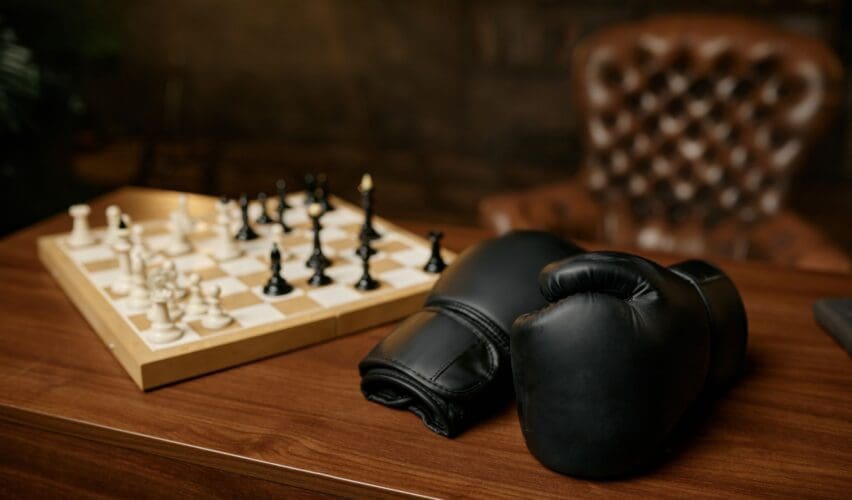
Chess-Boxing: A Masterclass in Stress Control
I was locked in, staring down a plastic knight on a black and white grid. My vision swam. My lungs burned like I’d just inhaled a lit cigar. Across from me, a guy nicknamed “The Python” had just spent three minutes trying to detach my head from my shoulders.
The bell rang.
“Move! Move!” the referee screamed.
My hands shook so violently I nearly toppled my King. I had to calculate a mate-in-three while my heart hammered against my ribs at 170 beats per minute. This wasn’t a nightmare. This was Tuesday.
This was chess-boxing.
Most people hear “chess-boxing” and chuckle. They picture nerds in oversized gloves or boxers squinting at a chessboard. It sounds like a punchline. But standing in that ring, sweating through my wraps onto the wooden board, I realized this ridiculous hybrid sport is actually the purest, most brutal lesson in stress regulation on the planet.
We talk about “stress management” in abstract, fluffy terms. We discuss breathing exercises in climate-controlled yoga studios. But until you’ve tried to solve a tactical puzzle immediately after dodging a left hook, you don’t know what stress actually does to your brain.
The Absurd Reality of the Square Circle
Here is the setup for the uninitiated: 11 rounds. Alternating between speed chess and boxing. You win by checkmate, knockout, or on time.
It sounds simple. It isn’t.
The problem isn’t the boxing. The problem isn’t even the chess. The problem is the switch.
In nature, you are either hunting or thinking. You are running from a bear, or you are figuring out which berries won’t kill you. You generally don’t have to solve a differential equation while the bear is chewing on your leg. Chess-boxing forces your nervous system to slam the brakes on a Ferrari doing 100mph, then immediately accelerate again.
I remember my first sparring session. I came out swinging. Rounds of heavy bag work, sparring, feeling flowy. Then the coach yelled “CHESS!” and I sat down.
My brain was a blank static channel.
I stared at the board and couldn’t remember how the Bishop moved. I’m rated 1600 ELO. I’m not a grandmaster, but I know how the pieces move. But in that moment? Nothing. Just blood rushing in my ears and the metallic taste of adrenaline.
That is what acute stress does. It makes you stupid.
Round 1: The Lizard Brain Takeover
When you are in the boxing round, your sympathetic nervous system is running the show. This is the “fight” part of fight-or-flight. Cortisol floods the system. Your pupils dilate. Blood shunts away from your digestive system and your prefrontal cortex—the part of you that does math, logic, and long-term planning—and goes straight to your major muscle groups.
Your body is screaming: Survive.
This is great for slipping a jab. It is terrible for the Queen’s Gambit.
Most of us live in a low-grade version of this state constantly. An email from your boss triggers the same biological tripwire as a fist flying at your face. The reaction is less intense, sure, but the mechanism is identical. Your heart rate ticks up. Your palms sweat. And, crucially, your IQ drops.
I found out the hard way that you cannot “force” yourself to focus when your physiology is in panic mode. I sat there, chest heaving, trying to analyze the board. I made a blunder a five-year-old would catch. My opponent, who had clearly mastered the art of calming down faster than me, took my Queen and smirked.
The bell rang. Back to boxing.
I was angry now. I went in aggressive. Sloppy. I got clipped with a body shot that knocked the wind out of me.

Hacking the Vagus Nerve
Between rounds, you have one minute to take your gloves off and put your headphones on. One minute. That sixty seconds is where the battle is won or lost.
This is the core lesson regarding nervous system regulation. You cannot control the stressor. The punch is coming. The deadline is looming. The market is crashing. You can’t stop that. You can only control how quickly you return to baseline.
I learned that I had to manually override my nervous system.
I couldn’t just “relax.” I had to aggressively engage my parasympathetic nervous system. I started using a double-inhale, long exhale breathing pattern immediately after the boxing round.
- Inhale through the nose.
- Pause.
- Another sharp inhale.
- Long, slow sigh out the mouth.
It sounds like weird hyperventilation, but it works. It offloads carbon dioxide and mechanically stimulates the vagus nerve, signaling the heart to slow down.
If I didn’t do this, if I just sat down and tried to “think,” I would lose. I had to treat my heart rate like a tachometer. If I was over 150 BPM, I simply played safe, defensive moves. I didn’t try anything brilliant. I just tried not to die on the board until my heart rate dropped below 130. Once it dropped, my peripheral vision returned. I could see the board again.
This is a massive takeaway for high-pressure work environments. If you are heated—if you just got off a contentious call or read a furious Slack message—do not try to make a complex decision. You physically can’t. Your brain isn’t online. You are operating on Lizard OS. Wait. Breathe. Force the reset. Then decide.
The Cognitive Cost of Physical Trauma
There’s another layer to this onion. Pain.
In the later rounds, you aren’t just tired. You hurt. Your ribs ache. Your nose might be bleeding. Trying to maintain intense mental focus when you are in physical pain is a specific type of hell. It forces a level of compartmentalization that borders on sociopathy.
I recall Round 7 of a particularly grueling match. My opponent had a longer reach and had been peppering my forehead with jabs. My head was throbbing. A headache is distracting when you’re trying to sleep; it’s debilitating when you’re trying to calculate a knight fork.
But the board doesn’t care about your headache. The clock is ticking.
I had to learn to separate the sensation from the reaction. The pain was just data. It was loud data, sure, but I didn’t have to listen to it. I had to stare at the squares and force my mind to narrow its aperture until the only thing that existed was e4 and d5.
This taught me about attentional gating. We constantly filter out sensory input. You don’t feel your socks until I mention them. You don’t hear the fridge humming until you listen for it.
Stress makes us hyper-sensitive to the wrong things. We fixate on the discomfort. We fixate on the fear.
Chess-boxing forces you to gate that out. If you focus on how tired your arms are, you miss the tactical line on the board, and you get mated. If you focus on the blunder you made on the board during the boxing round, you get knocked out.
You have to be entirely present in the current modality. Regret is a luxury you cannot afford.
Why Your Office is a Ring
You might be thinking, “Great, but I don’t get punched in the face for a living.”
Don’t you?
Maybe not physically. But the modern workplace is a series of cognitive uppercuts. We switch contexts so fast it causes whiplash. You’re deep in a spreadsheet (Chess), then you’re pulled into a crisis meeting (Boxing), then back to deep work, then a client is screaming at you.
We alternate between high-intensity creative problem solving and reactive fire-fighting all day long.
Most people are terrible at the transition. They drag the stress of the meeting into the deep work session. They stare at the screen, heart still pounding, wondering why they can’t focus.
They haven’t reset.
The “Switch” is a skill. It is a muscle. And like any muscle, it creates micro-tears when you use it. I noticed that after a chess-boxing session, I wasn’t just physically sore. I was cognitively shattered. I couldn’t decide what to eat for dinner. My executive function was bankrupt.
This validated something I’ve suspected for years: Willpower and focus are finite biological resources. You burn glucose and neurotransmitters when you force that switch. If you don’t respect the recovery, you burn out.
Train Your Brake Pedal
The biggest mistake I see high-performers make is they only train the gas pedal. They drink more coffee. They take nootropics. They psyche themselves up. They want to go harder, faster, longer.
In chess-boxing, if you only train the gas (aggression), you lose. You gas out in the boxing, or you play impulsive, stupid chess. The best fighters aren’t the ones who can get the angriest. They are the ones who can calm down the fastest.
It’s about Heart Rate Variability (HRV). A high HRV means your heart can ramp up when needed and snap back down instantly. It’s a sign of a responsive, flexible nervous system.
I started training my recovery as hard as my output. I’d do a sprint, get my heart rate to max, stop, and see how fast I could drop it by 30 beats. That was the game.
Apply this to your workday. Don’t just power through. When you finish a high-stress task, take two minutes. Literally two minutes. Reset your physiology. Don’t jump straight into the next email. If you carry the residual cortisol from Task A into Task B, you are just compounding the toxicity.
The Checkmate
I never became a world champion chess-boxer. I took enough hits to the head to realize I like my neurons exactly where they are. But the experience changed how I work.
I stopped viewing stress as an enemy to be avoided. Stress is just energy. It’s fuel. The problem isn’t the fuel; it’s the engine flooding.
When I feel that tightness in my chest now, I don’t panic. I recognize it. Ah, Round 3. Adrenaline dump.
I don’t try to fight the feeling. I acknowledge it. I take the double inhale. I wait for the fog to clear. And then, only then, do I make my move.
Because in the end, it doesn’t matter how hard you can hit. It matters how clearly you can think while you’re taking a beating.
Thanks for stopping by!
We’d love to know what you think. Drop a comment below with your feedback or suggestions—we can’t wait to hear from you.
– Best, Stable Grace Staff Writers & Editors