
Biohacking Your Sleep for Mental Clarity and Emotional Stability
I spent three years waking up at 4:00 AM with a heart rate that felt like a kick drum. My brain was a bowl of cold oatmeal. I’d crawl to the kitchen, shake a bottle of generic melatonin like a maraca, and wonder why I felt worse every single day. Everyone tells you to “get more sleep.” That advice is useless. It’s the equivalent of telling a starving person to “get more food.” It doesn’t tell you what to eat, when to eat it, or why your body is currently refusing to digest anything.
The industry surrounding sleep is a mess of overpriced mattresses and “natural” supplements that are mostly rice flour and hope. If you want mental clarity—that sharp, crystalline ability to solve a problem without wanting to punch your monitor—you have to stop treating sleep like a passive activity. You have to treat it like a biological heist. You are stealing your sanity back from a world designed to keep you wired, tired, and profitable.
The Magnesium Lie
Most people walk into a CVS, grab the first bottle of magnesium they see, and think they’ve solved their anxiety. They haven’t. They’ve likely bought magnesium oxide. That stuff has a bioavailability of about 4%. You’re basically swallowing expensive rocks that will do nothing but give you diarrhea at 6:00 AM.
If your brain feels like a browser with fifty tabs open, you need magnesium l-threonate. It’s the only form that effectively crosses the blood-brain barrier. I started taking it and the “static” in my head finally dimmed. It’s not a sedative. It doesn’t knock you out. It just stops the recursive loops of thinking about that awkward thing you said in 2012.
Then there’s magnesium glycinate. This is for the physical “buzz” of stress. If your shoulders are perpetually touching your earlobes, this is your fix. I take 400mg about an hour before bed. Don’t buy the gummies. They’re loaded with glucose syrup. Spiking your insulin right before you try to enter REM sleep is a recipe for a 2:00 AM cortisol spike. You’ll wake up wide awake and sweaty. It’s a miserable way to live.
The Temperature Obsession
Your core temperature needs to drop about two to three degrees Fahrenheit to initiate deep sleep. This is why you can’t sleep after a massive workout or a heavy meal. Your body is too busy radiating heat.
I keep my bedroom at exactly 64 degrees. My wife hates it. She looks like an Eskimo under four layers of wool, but I don’t care. The science is settled here. If your room is 72 degrees, you are fighting your own biology. Your brain will stay in light sleep, hovering on the surface like a buoy, never sinking into the restorative depths where the glymphatic system actually cleans out the metabolic waste of your day. Think of it as a power wash for your neurons. You can’t power wash a car if the garage is on fire.
I also started using a cooling pad on the mattress. It’s a grid of silicone tubes that pumps cold water under your body. It sounds like a gimmick. It feels like sleeping on a slab of marble. But it changed my life. My “Deep Sleep” metrics on my tracker jumped from twenty minutes to ninety minutes in a single week. The mental fog didn’t just lift; it evaporated.
The Blue Light Myth and the Lux Reality
We’ve all heard about blue light. We buy the stupid orange glasses and put “Night Shift” on our iPhones. It’s a start, but it’s mostly theater. The real issue isn’t just the color of the light; it’s the intensity.
Lux is the measurement of light hitting your eyes. Your suprachiasmatic nucleus—the tiny clock in your brain—doesn’t just look for “blue.” It looks for brightness. If you have overhead LED lights on at 9:00 PM, you’re telling your brain the sun is directly overhead. Melatonin production shuts down instantly.
I replaced every bulb in my bedroom and bathroom with red-spectrum, low-wattage bulbs. My house looks like a crime scene or a cheap brothel after 8:00 PM. I don’t care. When I walk into the bathroom to brush my teeth, I’m not blasted by 2,000 lux of “Daylight White.” I stay in a dim, red haze. My brain stays convinced it’s nighttime.
Try this: turn off every overhead light in your house three hours before bed. Use floor lamps. Use candles if you have to. If you can see clearly across the room, it’s too bright.
Mouth Taping: The Hostage Look
This is the one that makes people think I’ve joined a cult. I tape my mouth shut every night with a small strip of 3M micropore tape.
Modern humans are mouth breathers. It’s a disaster for our health. Mouth breathing triggers the sympathetic nervous system—the “fight or flight” response. It dries out your gums, ruins your oral microbiome, and ensures you’ll wake up with a headache.
Nasal breathing, on the other hand, increases nitric oxide production. It filters the air. It forces your diaphragm to actually work. The first night I did it, I was terrified I’d suffocate. I didn’t. I woke up feeling like I’d actually inhaled oxygen for eight hours straight. My emotional stability during the day became my superpower. I stopped snapping at people. I stopped feeling that mid-afternoon “doom” where everything feels impossible. I was just… level.
The Caffeine Half-Life Trap
I love coffee. I dream about my morning pour-over. But most people have no idea how caffeine actually works. It has a half-life of about five to six hours. If you have a “pick-me-up” espresso at 4:00 PM, half of that caffeine is still swimming in your brain at 10:00 PM. A quarter of it is still there at 3:00 AM.
You might “fall asleep” just fine. Alcoholics fall asleep fine, too. But you aren’t getting quality sleep. Caffeine blocks adenosine receptors. Adenosine is the chemical that builds up all day to create “sleep pressure.” If the receptors are blocked, the pressure is there, but your brain can’t feel it. When the caffeine finally wears off in the middle of the night, all that adenosine hits at once. You wake up in a panic.
I have a hard cutoff at 11:00 AM. No exceptions. If I’m tired at 2:00 PM, I take a cold shower or I go for a walk. If you need caffeine to function in the afternoon, your sleep is broken. Using more caffeine to fix it is like trying to put out a fire with gasoline.
The Orthosomnia Trap
There is a dark side to all this biohacking. It’s called orthosomnia—an unhealthy obsession with getting perfect sleep data.
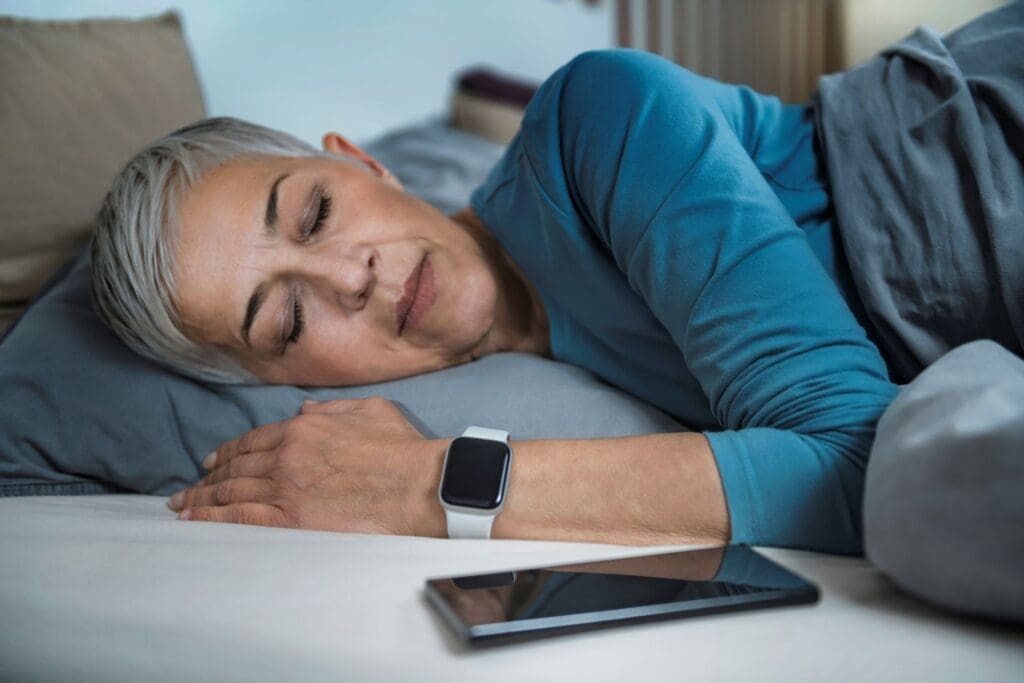
I’ve been there. I’d wake up, check my Oura ring or my Whoop strap, see a “Sleep Score” of 62, and immediately feel like garbage. I let a piece of plastic tell me how I felt. If the ring said I was rested, I had a great day. If it said I was “at risk,” I acted like a victim.
You have to learn to use the data as a compass, not a cage. If your metrics are low, don’t panic. Ask why. Did you eat a late pizza? Did you have two IPAs? Use it to spot patterns, not to judge your worth as a human being. The stress of trying to sleep perfectly is, ironically, the fastest way to ensure you never sleep again.
The Morning Light Reset
Everything I’ve talked about happens at night, but the most important sleep hack happens at 7:00 AM. You need photons in your eyes as soon as possible after waking up.
Not through a window. Glass filters out the specific blue-sky wavelengths needed to set your circadian clock. You need to go outside. Ten minutes on a sunny day, twenty minutes on a cloudy day. This sets a timer in your brain. It tells your body to start producing serotonin, which will eventually be converted into melatonin fourteen hours later.
If you spend your morning in a dark apartment looking at a laptop, your body never truly “wakes up” biologically. You’ll be in a trance all day, and then you’ll wonder why you can’t shut down at night. Your internal clock is drifting. Anchor it.
Supplements That Actually Work (and the ones that don’t)
Stop taking 5mg or 10mg of melatonin. It’s an insane dose. Your body naturally produces picograms of the stuff. Taking 10mg is like trying to fix a leaky faucet with a firehose. It desensitizes your receptors and can mess with your other hormones. If you must use it for jet lag, take 0.3mg. Yes, point three.
What actually works for emotional stability? Apigenin. It’s a derivative of chamomile. It’s a very mild GABA activator. It takes the edge off. Also, L-Theanine. If you’re a high-cortisol person who vibrates with stress, 200mg of L-Theanine is like a warm hug for your nervous system.
But supplements are the last 5%. If your room is hot, your lights are bright, and you’re breathing through your mouth, no pill on earth is going to save you.
Why Does This Matter?
We live in an era of “functional exhaustion.” We’ve accepted that being tired is just part of being an adult. It’s not. It’s a symptom of a biological mismatch.
When you fix your sleep, your personality changes. You become more patient. Your “working memory”—the ability to hold multiple ideas in your head at once—doubles. You stop reaching for sugar to stay awake.
I don’t do this to live forever. I do it because I want the sixteen hours I’m awake to be high-definition. I’m tired of living in 480p. I want the clarity. I want the stability. I want to look at a crisis and feel absolutely nothing but the calm resolve to fix it.
Are you going to keep staring at the ceiling tonight, or are you going to buy some tape and turn off the lights?
Thanks for stopping by!
We’d love to know what you think. Drop a comment below with your feedback or suggestions—we can’t wait to hear from you.
– Best, Stable Grace Staff Writers & Editors