
Name Your Inner Critic (Give It a Ridiculous Name)
I once called my inner critic ‘Barnaby the Tax Collector’ after a brutal line-edit that sounded suspiciously like a countdown. The name stuck. The voice felt smaller.
Why Name the Inner Critic?
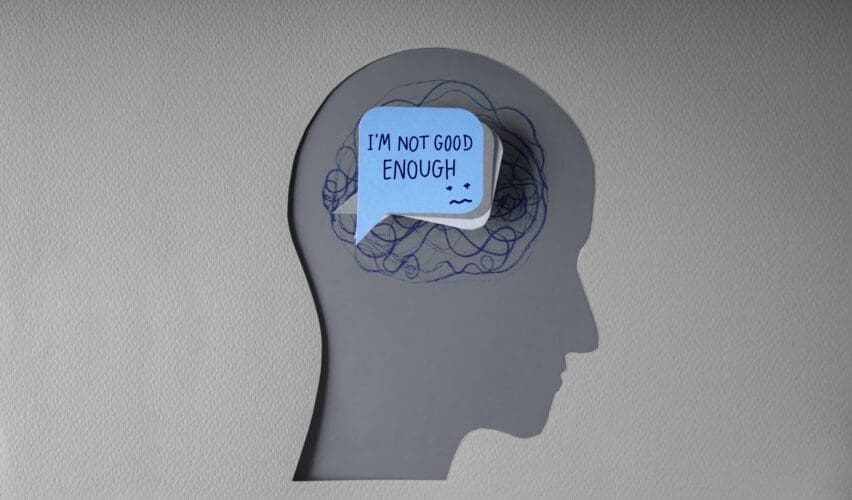
My inner critic used to sound like me. Same tone. Same timing. Same smug little “helpful” comments right when I hit Send on an email or watch the upload bar crawl across the screen. That’s the problem. If it sounds like me, I treat it like truth.
The personification technique creates cognitive distance
Giving that voice a ridiculous name is a cheap trick that works. I’m serious. The personification technique turns a foggy, invasive feeling into a character I can point at. “Oh, that’s not my wisdom speaking. That’s Barnaby the Tax Collector again, auditing my personality.”
This is where cognitive distance shows up. Research on labeling intrusive thoughts backs the idea that naming a thought helps you step back from it instead of fusing with it. When I label it, I can spot it faster. It becomes a notification, not a command. Like seeing a pop-up and thinking, “Nope,” before it hijacks the whole browser.
Naming makes the inner critic easier to catch in the act
The inner critic loves speed. It slides in during tiny moments: when I reread a text and notice a double space, when I hear my voice crack on a call, when I remember that one weird thing I said in 2014. Naming slows it down. Now I can say, “Barnaby, you’re early. I haven’t even made coffee.”
Dr. Emily Stanton: “Giving a thought a silly name reduces its grip and opens space for humor.”
Humor breaks the spell
Humor doesn’t argue with the critic. It shrinks it. The absurdity reframes the critique as less authoritative, which can lower the perceived intensity of self-criticism. If Barnaby tells me, “You’re going to embarrass yourself,” I picture him in a tiny visor, stamping forms, furious that I didn’t file my “Permission To Be Human” paperwork.
Even when the criticism is about real standards, I’d rather hear it from a clown than a judge. Jerry Jenkins said, “Spelling, punctuation, and grammar errors are immediately noticed by editors.” Fine. Useful. Barnaby still doesn’t get to call me a failure over a comma.
So pick a name that makes you snort-laugh. Then wait for the inner critic to speak up and try not to answer it like it’s the boss.
How to Pick a Ridiculous Name
I once named mine “Barnaby the Tax Collector,” and my brain instantly stopped treating the thought like a prophecy and started treating it like a guy who’d argue about stapler receipts. That’s the whole trick when you name your inner critic: absurdity creates distance fast. Research-backed or not, I can tell you what happens in real life—you feel a tiny emotional shift, like someone cracked a window in a stuffy room.
Go oddly specific, not vaguely mean
Skip “Jerk” or “Loser.” Too direct. Too hot. You want something with a job title, a weird hobby, or a petty mission. Think accountant, disgruntled mail carrier, bored game-show host, mall security guard who takes the food court personally. The more specific, the less your nervous system buys the message.
Also, don’t pick anything flattering. “Captain Genius” turns your critic into a celebrity. Bad move. The point of naming intrusive thoughts is to shrink their authority, not give them a podcast deal.
Use personal and cultural references (the safe kind)
I like names that feel like a character from a sitcom rerun or a neighbor you’d avoid at the mailbox. “Darla from HOA,” “Professor Buzzkill,” “Gary the Spreadsheet Goblin.” If you grew up with a certain cartoon villain or a very specific teacher voice, borrow that vibe. Your brain recognizes it as “character,” not “truth.” That’s one of my favorite self-talk strategies because it’s fast and it doesn’t require a mood makeover.
Run a 5-minute name trial
Set a timer for five minutes. Try three name variations in one session. Say each one out loud twice, then respond like you’re talking to a ridiculous roommate: “Thanks, Barnaby. I’m still sending the email.” Watch your body. Smile? Eye-roll? Even a tiny snort counts.
Quick test: if the name makes you tense, it’s too sharp. If it makes you smirk, keep it.
Amy Johnson: “I told mine ‘Ms. Penny-Pincher’ and I stopped freezing for whole afternoons.”
Try it daily for a week. If the name stops working, rename the clown. What’s your critic’s worst possible job title?
Scripts: What to Say Back
My inner critic loves timing. It waits until I’m holding my phone over the “Post” button, then hisses, “Everyone will think you’re dumb.” Cute. I don’t argue with it like it’s a serious adult. I treat it like an annoying internal roommate who keeps leaving passive-aggressive sticky notes on the fridge.
The trick with self-talk strategies is speed. If I start giving a TED Talk to my own brain, I’m already stuck in the mud. I keep comebacks short and ridiculous. One to three words. That’s it. Dr. Marcus Lee puts it cleanly:
Dr. Marcus Lee: “Short scripts help interrupt rumination quickly and shift attention.”
The 40-second loop (simple, repeatable)
I use a tiny cycle because repeatable scripts turn into habit faster than “deep insights” I’ll forget tomorrow.
- 10-second label: “Oh good, Barnaby’s back.”
- 10-second reply: “Noted, Barnaby.”
- 20-second grounded breath: inhale 4, exhale 6, eyes on one object (mug, doorframe, my thumb).
I repeat that 3–5 times. It’s boring on purpose. Boring beats spiraling.
Roleplay it: narrator → critic → you
This is my favorite humor therapy move for intrusive thoughts, because it creates distance fast.
Narrator (neutral): “A thought has arrived.”
Critic (dramatic): “You’re going to mess this up.”
Me (to the silly name): “Thanks for the memo, Ms. Penny-Pincher.”
Narrator: “The thought is still here.”
Critic: “They’ll judge you.”
Me: “Okay, Barnaby.”
Mute the world for 10 minutes
Practice fails when my phone keeps chirping like a needy bird. I open Settings, hit Do Not Disturb, and set it for 10 minutes. Or I tap the little bell icon in my email app and choose Mute notifications. Less interruption means my script actually gets reps.
My go-to micro-comebacks
- “Sure, Barnaby.”
- “Cool story.”
- “Not today.”
- “Thanks, Cheryl.”
- “File it.”
Pick one. Say it out loud. Make it stupid. Then hit “Post” anyway.
When It Helps (Real Examples)
The moment I see a Gmail red “1,” my brain acts like it’s a fire alarm. I’ll hover over the inbox, already writing a disaster movie in my head. That’s when I use naming intrusive thoughts as a cue: “Nice try, Barnaby the Tax Collector.” I say it under my breath before I click anything. Then I do one tiny, boring action on purpose—open the message, read the first line, close it if I need to. The tech trigger stays the same, but the intrusive thoughts lose some authority because they’re coming from a ridiculous character, not an all-knowing narrator.
Writer’s block: the perfectionist edit spiral
Drafting is where my inner critic turns into a petty copy editor with a whistle. I’ll type three sentences, then backspace like I’m erasing evidence. Jerry Jenkins has pointed out that spelling and punctuation errors grab attention fast, and my brain uses that fact as an excuse to stop writing entirely. So I name the critic something dumb—“Captain Semicolon”—and I talk back like I’m dealing with an annoying roommate.
“Captain Semicolon, you can complain after the draft.” Then I set a 10-minute timer and forbid myself from fixing anything except truly unreadable typos. Five to 20 minutes a day is enough practice to make this feel automatic, especially if you tie it to a repeatable cue like the moment your cursor blinks on a blank page.
Social anxiety: the pre-meeting shame forecast
Five minutes before a meeting, my mind loves to run intrusive thoughts like: “You’ll sound stupid,” “They’ll notice your voice,” “You’ll forget your point.” I label it immediately. “Oh, it’s Baroness Doomscroll again.” The goal isn’t to feel brave. It’s to create distance so I can still show up.
Samantha Ruiz: “I whispered ‘Barnaby’ before a client call and the shame lost its immediate edge.”
Body-image hits: use smell and texture to ground it
This one gets me in the kitchen. I’ll catch my reflection while waiting for toast, and the critic starts in. I name it—“Duchess Diet Police”—then I ground myself in what’s real: the warm, yeasty smell, the rough crust, the butter melting into the crumb. “Thanks, Duchess. I’m eating breakfast.” Then I take the bite anyway. Want to try it the next time your brain starts heckling you mid-chew?

Pitfalls and Tips
I once named my inner critic “Captain Spreadsheet” and immediately regretted it. Every time I hesitated, my brain pictured a smug little man tapping a calculator, and somehow that made me feel more judged, not less. That’s the first pitfall: the name isn’t a cage for the thought. It’s a flashlight.
Don’t turn the name into avoidance
This is a noticing tool, not a trapdoor. If you slap a silly label on a thought and then sprint away from it, you’re not building cognitive distance—you’re rehearsing panic with a clown nose on. I try a quick script: “Oh hey, Captain Spreadsheet. You’re doing the thing.” Then I go back to the email, the dishes, the hard conversation. The point is to keep moving while using self-talk strategies that stay grounded in real life.
Dr. Emily Stanton: “The goal is distance, not suppression; adjust the approach if it strengthens the critic.”
If the name backfires, switch fast
Some labels accidentally reinforce shame. If your “ridiculous” name still feels like a personal insult, ditch it. No loyalty program here. I’ve swapped names mid-thought like I’m changing a bad ringtone. Monitoring my emotional response is the whole game; if I feel smaller, tighter, or meaner to myself, the name is wrong.
Watch for rumination creep
Naming can turn into a mental health technique you overuse, especially if you start narrating every thought like you’re hosting a reality show inside your skull. If you notice extra looping after you name the critic, shorten the script and add one grounding breath. In through the nose, slow out through the mouth, then back to the task. Keep it plain.
Keep it brief so it doesn’t become a ritual
Short, adjustable practice prevents ritualization. I cap sessions at 5 minutes. If rumination increases, I cut it to 60–90 seconds and stop. No gold stars for endurance.
If you want cleaner self-editing without feeding the critic, Jerry Jenkins has solid craft advice, and HBR’s editing pieces are good for tightening writing without turning it into self-punishment. Now pick a name that makes you smirk—does yours make you feel lighter or hunted?
TL;DR: Give your inner critic a goofy name, talk back with short, humorous lines, and use brief roleplays to build cognitive distance—practice 5 minutes a day.